
An absolutely hilarious and trenchant statement from my mom's boyfriend -- spoken to me as I was writing the below post, it was immediately obvious that this should begin the post. As Mel would say "Nothing happens by accident"
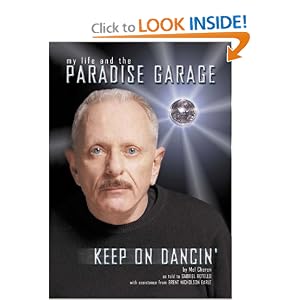
As it turns out, this book is more than just the 'perfect present on paper' -- or what would be the most logical and relevant gift. It's the real deal. My continued research of the paradise garage could only go so far before this book. Many of the clubs, djs, and records that changed the way people understand dance music, popular music, and gay culture are COMPLETELY undocumented. More than simply an integral member of the disco movement ("Godfather of Disco") -- he was a record producer who worked at ABC/Paramount throughout the 50's and 60's, and his work contains ample commentary and ideas on the continuing shape of popular music during this time.
"While the rest of the world screamed for the moptops from England, I and a lot of my friends were happier boodying down to the cooler, smoother , more danceable sounds of Motown and r&b. In a way, the later distinction between disco and mainstream rock had roots right back here. British boys were masturbating their guitars; black Americans were working out rhythm and dance routines and exploring novel ways to make you boogie"
I had always been suspicious of the notion that anything the beatles did, musically speaking (not including overall love/hedonism), affected house music, disco, and the overall progression of r&b in america. Disco never needed twist and shout to popularize dancing. There was an undercurrent of Motown lovers the whole time. This more underground, dance oriented subsect of gay, black men who were part of NYC fashion and music would be the same ones to light the disco torch, and carry it through its many phases, regardless of what was popular. This is the same group of people that would set the trends for interesting music and culture for decades, and would love each other fully and easily, even when Straight culture had dismissed "free love" as a trend. I had never felt so confirmed as reading that passage, and my journey into the book had just begun.
Disco was always an umbrella term for the "type of music" that influential disc jockeys liked to play at the time -- what made them dance -- rather than a genre defined by specific instruments and artists. A term used by many of the older scene-queens that describes it properly, is "Danceable R&B" -- and it makes proper sense when you are listening to it.
---
Describing my fundamental disappointment with rock music, has not only been difficult for me throughout life, but has often been caustic and painful for friendships with people who never understood how I felt about rock or how I could be so into music, but so negative towards rock culture.
"Given that disco eventually came to dominate the record industry and sell billions of dollars worth of records, it produced relatively few bona fide stars. Almost none. And that was no accident. Some have argued that the primary reason was that disco was more a producer's medium, and that is certainly true. But it's just as true that, unlike rock, disco did not need stars; they were beside the point. The point was joy and ecstasy and self-expression. The point, for many gay men and many African-Americas and working-class urban kids, particularly Italians, was building a community out of dance."
How could I describe it better, than to point out what is so great about the other type of culture? No point in trashing a group of strange and crazy super stars clamoring for who could be the king of cool, king of america, etc. Why pretend to like endless guitar solos and crooning sob songs over an outdated shuffle. A group of people (and i'd like to note that this is true regardless of their status as oppresed people or second class citizens) created a culture based on rhythm, dance and celebration, and reinvented "cool" as well as their own identities, and did so in a very personal and artistic environment.
Please compare for a moment, the "stadium rock concert" vibe. Endless waves of teenagers, each with a concerned parent out there in the world, screaming and yelling at a distant idol, who they will never know or interact with -- celebrating their greatness from afar. Each person patiently waiting to hear a set of songs they already know -- so they can cherish all three minutes.
It's hard to not acknowledge the difference: the first is a cultural phenomenon relating to the desire to dance and celebrate -- the second is explicitly a commercial enterprise.
There were three styles of disco music.
1. Pop-disco
examples...
Bee-Gees
Anita Ward "Ring My Bell"
KC & the Sunshine Band
Chic
Average White Band
ABBA "Dancing Queen"
This is the popular conception of what "disco" means. Popular at the time both with the frenzied masses, and to a lesser degree, with the white Gays @ the Flamingo club.
2. Danceable R&B
Taana Gardner "heart beat"
LTD http://www.youtube.com/watch?v=461icTVca60
Jocelyn Brown
Gayle Adams // "Your Love is a Life Saver" http://www.youtube.com/watch?v=VNkNhtpC9i0
Jimmy Ross "first true love affair"
Black, gay, funky -- the music of the Paradise Garage -- a style very popular with Larry Levan and the many people that waited to hear his selections week after week. This music catered to a group of people interested in dance, the soul, and a moving sense of gay identity and freedom -- blind to (or just not looking at) the massive popular appeal of the first category. The evolution of this music into House was natural and funky.
3. Italo Disco
Donna Summer
Giorgio Moroder
Sylvester
Also called Euro-Disco -- this is the element which enabled the second category to become house music. Hungry Chicago producers used the electronic elements brought into the music as a cheap replacement for orchestral arrangments, studio mixers, and vocal divas. This would create a magic and electronic high on the dancefloor and open the doors for Danceable R&B to move into it's next phase.
---
The freshest artists were not afraid to combine lyrical styles, italo disco, and the danceable R&B into fluid musical motion, and the most creative DJs embraced it all and loved it.
These people were also responsible for a number of fundamental innovations in DJing, without which modern DJ's would still be human jukeboxes.
-using more than one turntable
-using multiple copies of the same record
-playing records back to back immediately to keep the energy
-transitioning, or "changing" records seamlessly
-using extended drum breaks ("the disco break") as a way to extend a dancefloor groover
-using three turntables simultaneously
-using instrumental mixes and acapellas to both extend and re-invent records
-using EQ to cut out certain frequencies and enhance the experience
-remixing studio songs to work better on the dancefloor (these studio sessions are where "remixing" game from and are a beautiful gift from Tom Moulton)
-using louder, bigger 12 inch records to get more into each groove.
The list goes on, and on and on. I'm going to see Harry Potter with my mom, and get my Wizard on (HOT) -- but I will continue these many thoughts later.

No comments:
Post a Comment